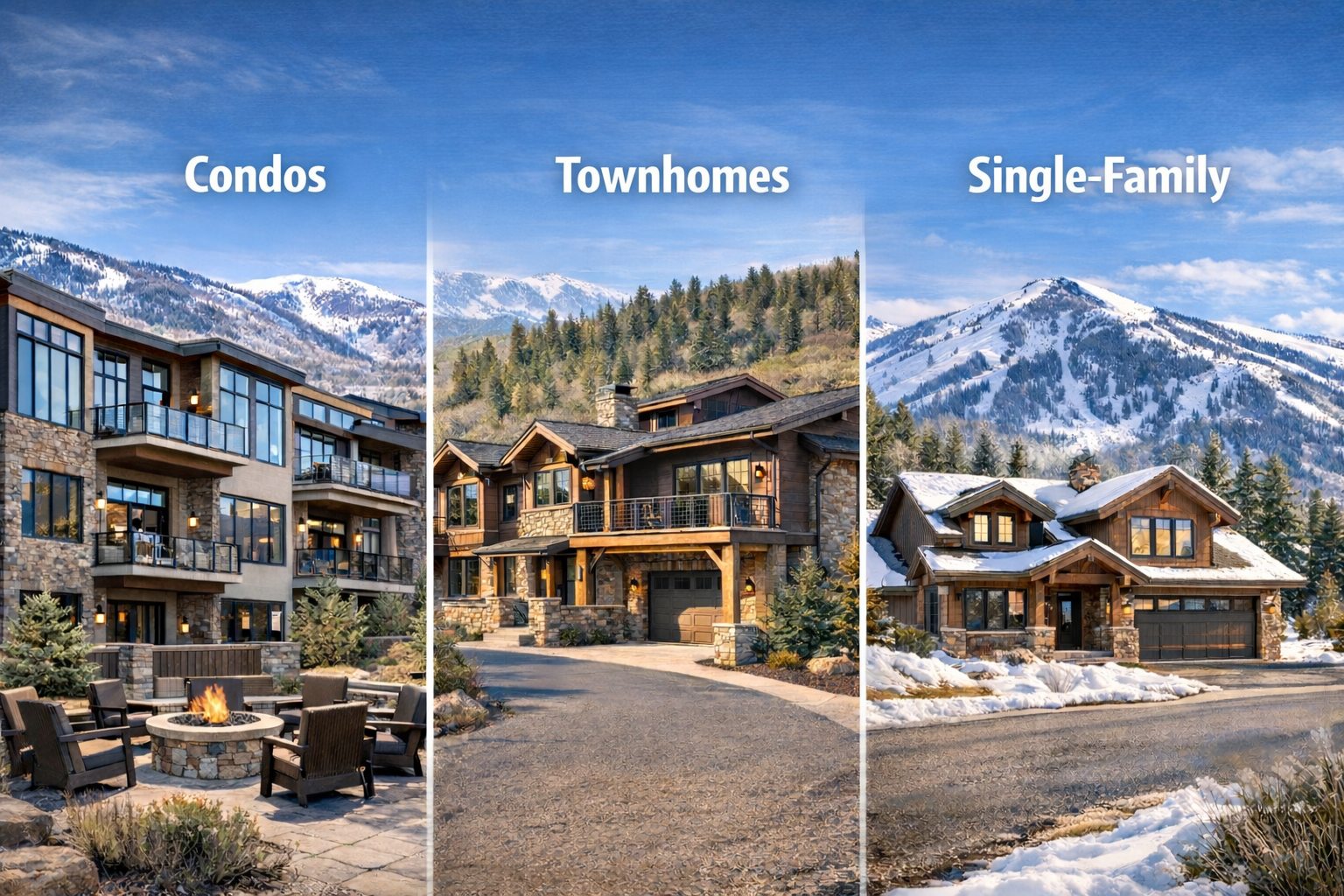
Which Park City investment property type is “best” right now—condo, townhome, or single-family—once you compare cap rate, HOA costs, and rental rules?
Condos often pencil best for nightly rentals (if allowed) but HOA and restrictions can erode returns; townhomes balance revenue and control; single-family can command premium ADR yet faces higher costs, seasonality, and tighter rental-rule risk.
If you’re underwriting Park City real estate the way serious buyers do—cap rate, cash-on-cash, HOA line items, and the fine print on rental rules—you’ve already moved past “Is Park City a good market?” and into “Which exact property type wins for my strategy?”
Right now, the “best” Park City investment property isn’t a single answer. It’s the asset type that matches your intended use (personal nights vs pure income), your tolerance for operational complexity, and your micro-market’s rental permissions. Two properties with the same purchase price can perform wildly differently once you account for:
- Nightly rental eligibility (and enforcement risk)
- HOA dues + special assessments (and what they actually cover)
- ADR and occupancy sensitivity across seasons
- Unit livability (parking, storage, ski access, hot tubs) that drives reviews and repeat bookings
- Financing constraints (warrantability, reserve studies, insurance, LTV)
Below is the decision framework I use with out-of-area and absentee owners: compare condos vs townhomes vs single-family through the lens of real underwriting—with pro-forma examples, “deal viability” checkpoints, and the rental-rule logic that can make or break your plan.
1) Start With the Only Question That Matters: What Rental Strategy Is Actually Allowed?
In Park City, your returns are less about “condo vs house” and more about whether nightly rentals are permitted and practical for the specific property. You can underwrite a great cap rate on paper and still lose the deal if the HOA or jurisdiction effectively blocks your strategy.
You typically have three operating models:
Nightly/short-term rental (STR)
Highest gross revenue potential when allowed, but it’s the most sensitive to rules, reviews, and management execution.
Mid-term rental (30+ days)
Often a strong middle ground when nightly isn’t allowed. Demand can come from seasonal workers, families remodeling, travel nurses, or “try-before-you-buy” relocations.
Long-term rental (12 months)
Most stable and the easiest to manage, but in resort markets it can underperform relative to a well-run STR.
Here’s the decision reality: condos are most likely to be set up for STR operations (front desks, centralized amenities, consistent layouts), but they also come with the tightest governance via HOAs and, sometimes, brand/management programs. Single-family homes can produce premium ADR and “headline” revenue, but they’re also where you’ll see more neighborhood friction, stricter HOA covenants, and higher cost volatility (snow removal, hot tubs, driveway heat, insurance).
What you should verify before you get attached to a listing:
- City/county STR rules for the property address (licenses, zones, enforcement posture)
- HOA/COA governing docs: CC&Rs, rules & regs, leasing addenda, fines schedule
- Minimum stay requirements (some HOAs restrict stays under X nights)
- Caps/quotas on rental permits, or “owner must be present” clauses
- Management requirements: on-site desk, approved vendor list, check-in policy
- Parking, trash, noise rules (these hit reviews and can trigger HOA violations)
If you’re an absentee owner, assume your “risk” is not only legal compliance—it’s operational compliance: can your manager execute within those rules every weekend in peak season?
2) Condos: Often the Best STR Math—Until HOA, Warrantability, and Assessments Enter the Room
Condos frequently look like the cleanest investment story in Park City because they can offer:
- Strong nightly rental demand near lifts, Main Street, and resort transit
- Lower “surprise” maintenance on exterior items (roof, siding)
- Amenities that boost ADR: hot tubs, pools, fitness, shuttle service, ski storage
But condos are also where investors get blindsided. Your underwriting needs to treat the HOA not as a footnote, but as a core expense line with balance-sheet risk.
How condos typically win
- Higher occupancy consistency in core resort nodes during ski season
- Easier guest experience (elevators, front desk, predictable layouts)
- More comparable data for revenue forecasting (similar units in same building)
Where condos typically lose
- HOA dues can be substantial, and you don’t control future increases.
- Special assessments can materially change your returns (insurance, roofs, deferred maintenance).
- Financing constraints: “non-warrantable” condos can reduce your buyer pool later and can impact your own loan options now.
Pro-forma example (condo STR concept)
Assume a 1–2 bedroom condo where STR is allowed:
- Gross booked revenue: $110,000/year
- Less: management + booking + CC fees (25% blended): -$27,500
- Less: cleaning (often passed through, but assume partial owner burden): -$3,000
- Less: utilities/Wi-Fi: -$4,500
- Less: HOA dues: -$12,000
- Less: insurance (interior/HO6): -$1,200
- Less: repairs/maintenance reserve: -$3,500
Net operating income (NOI): ~$58,300
Now pressure-test it: if HOA rises 15% and revenue drops 10% in a weaker snow year, NOI can compress quickly. That’s why the “best Park City condo investment” is usually the one with:
- Proven rental history and clean rulebook
- Adequate reserves and transparent HOA financials
- Strong owner-review culture (well-maintained common areas)
- A layout that rents (true bedroom count, parking, storage)
If you’re buying for both lifestyle and income, condos can be excellent—just treat the HOA like a business partner you can’t fire.
3) Townhomes: The Underwritten Sweet Spot for Many Buyers (Control + Demand + Manageability)
Townhomes tend to be the “it depends, but often yes” answer for serious Park City investors—especially buyers who want more privacy and storage than a condo, but don’t want the full maintenance and cost volatility of a single-family home.
Why townhomes can be the best Park City investment property type for many decision-stage buyers:
- More livable for families and longer stays (which stabilizes occupancy)
- Often include garages, mudrooms, and owner storage—huge for ski guests
- Better sound separation and “home feel,” which supports higher ADR than many condos
- HOA dues can be lower than full-amenity condo buildings (not always, but often)
The underwriting nuance: townhome HOAs vary dramatically. Some are light-touch (roads + landscaping), while others are quasi-resort (shuttles, pools, extensive snow services). Your job is to translate that into your NOI.
Pro-forma example (townhome STR or mid-term)
Assume a 3-bed townhome with strong ski access where STR is permitted:
- Gross booked revenue: $160,000/year
- Management/booking fees (22% blended): -$35,200
- Utilities + hot tub + Wi-Fi: -$9,000
- HOA dues: -$7,800
- Insurance (higher than condo): -$3,000
- Snow/landscape (if not in HOA): -$2,500
- Repairs/maintenance reserve: -$7,500
NOI: ~$95,000
Townhomes can outperform because they’re often the most “repeatable guest product”: a garage, a hot tub, easy access, and sleeping capacity that matches group travel patterns. But you still need to confirm:
- Whether STR is allowed by both jurisdiction and HOA
- Whether there are minimum-night rules that reduce peak-weekend optimization
- Whether there are rental caps/quotas
- Whether parking rules will hurt guest experience (and reviews)
If you want fewer moving parts than a single-family but more revenue potential than many condos, townhomes are frequently where the numbers and lifestyle align.
4) Single-Family Homes: Highest ADR Potential, Highest Variance (and Rule/Neighbor Risk You Must Price In)
Single-family homes are the trophy asset—and in Park City they can command premium nightly rates, especially when you have views, privacy, design quality, and a strong amenity set (hot tub, media room, gear storage, multiple living areas).
But “premium” cuts both ways: your costs and your risk premium rise too.
Where single-family can win
- Top-end ADR for luxury groups and longer holiday bookings
- Strong personal-use enjoyment (which matters for second-home investors)
- Ability to add value via design, furnishing, and amenity upgrades (within rules)
Where single-family can lose
- Operating cost volatility: snow management, roofs, driveway issues, heating, hot tubs, landscaping, pest control, higher insurance.
- Occupancy sensitivity: luxury bookings can be more elastic in macro downturns.
- Rental-rule fragility: HOAs and neighborhoods can be less STR-friendly, and enforcement can be more personal and complaint-driven.
Pro-forma example (single-family STR concept)
Assume a 4–5 bedroom home positioned for luxury STR (if allowed):
- Gross booked revenue: $240,000/year
- Management/booking (20% blended): -$48,000
- Utilities (larger footprint): -$16,000
- Snow/landscape: -$9,000
- Hot tub/service: -$2,400
- Insurance: -$7,500
- Repairs/capex reserve: -$18,000
- HOA (if applicable): -$3,600
- NOI: ~$135,500
Looks great—until you stress-test it. If revenue drops 15% (macro softness or shoulder-season weakness) while fixed costs remain, your NOI compresses hard. That’s why the “best” single-family investment is usually one with:
- A defensible guest story (views, proximity, layout, parking)
- Low friction operations (easy driveway, robust HVAC, manageable snow zones)
- Clear, documented rental permissions
- A plan for capex (roofs, decks, exterior staining) rather than hoping it won’t happen
If you’re an out-of-area buyer, single-family can absolutely work—just underwrite it like a hospitality business with a real maintenance schedule, not like a passive rental.
5) Cap Rate, HOA, and Rental Rules: A Practical Comparison + Deal Viability Checklist
Cap rate in resort markets is often misunderstood because STR income behaves like a business. Still, you can compare deals intelligently if you use consistent assumptions and include all recurring expenses.
Quick comparison (typical tendencies)
Condos
- Cap rate potential: moderate to strong if STR is allowed and HOA is reasonable
- HOA impact: highest governance + assessment risk
- Rental rules: often clearly defined, sometimes strict (and enforced)
Townhomes
- Cap rate potential: strong when STR is allowed; often best “balance”
- HOA impact: moderate, varies widely by community
- Rental rules: mixed—must verify; can include minimum stays or cap
Single-family
- Cap rate potential: high headline revenue, but higher variance
- HOA impact: sometimes none, sometimes meaningful (gated communities, private roads)
- Rental rules: most sensitive to neighborhood dynamics and complaint risk
Deal Viability Checklist (use this before you write an offer)
Underwrite these items in writing—don’t rely on assumptions:
Rental permission proof
- HOA docs + jurisdiction rules + any permit status/transferability
Revenue reality check
- Compare to true comps (same bed/bath, same access, similar finish level)
- Adjust for seasonality, not just peak weeks
HOA due diligence
Budget, reserves, insurance coverage, delinquency rate, recent minutes
Upcoming capital projects and assessment history
Operating cost model
- Management fees (and what’s included)
- Utilities, snow, hot tub, consumables, repairs reserve, linens replacement
Exit liquidity
- Condo warrantability / financing constraints
- Buyer pool for your exact micro-market and price band
Personal use vs income clarity
- Blocked owner nights reduce revenue; model it explicitly
If you want the cleanest “decision,” choose the property type where rules are clear, the HOA is financially healthy, and your revenue is resilient—not just the one with the highest projected gross income.
________________________________________________________________________________
FAQ
Are condos or townhomes better investments in Park City?
If nightly rentals are allowed, condos can produce efficient STR operations, but HOA costs and assessment risk can reduce returns. Townhomes often provide the best balance of ADR, storage/parking, and manageable HOA—making them a common “sweet spot” for investors who also use the home.
How do HOA rules affect short-term rental income?
HOA rules can restrict minimum stays, require approved managers, limit guest behavior (parking/noise), or cap the number of STR units. Even when STR is legal in the city/county, the HOA can still prohibit or heavily constrain it—directly impacting occupancy, ADR, and your risk profile.
What cap rate should I expect for a Park City investment property?
Resort-market cap rates vary widely based on STR eligibility, seasonality, and HOA/operating costs. Instead of chasing a single “target cap rate,” you’ll make better decisions by running sensitivity scenarios (e.g., -10% revenue, +15% HOA/insurance) and confirming rules and reserves.
The best Park City investment property—condo, townhome, or single-family—is the one that survives real underwriting: rental rules you can prove, HOA costs you can trust, and an operating model that still works when occupancy or ADR softens.
If you want, I can send you a Park City investment pro-forma template + a rental-rules/HOA due diligence cheat sheet, and you can share a listing (or two) you’re considering for a quick return estimate based on your exact goals (STR vs 30+ day vs long-term, and personal-use nights).